
When the first monsoon clouds settle over the plains, the dark edges of a Mithila village begin to blink. A few tiny sparks drift over the paddy, a few more hover above the pond, and before long the mango orchard is dotted with small yellow-green lights that appear and vanish without a sound. In Maithili, this insect is the bhagjogni. Hindi speakers call it jugnu, and in Nepali it is the junkiri. Scientists call it a firefly, which is slightly wrong, because it is neither a fly nor on fire. The truth behind that light is stranger than the name.
What Exactly Is a Bhagjogni?
A bhagjogni is a beetle. Fireflies belong to the family Lampyridae, and like other beetles they carry a pair of hard wing covers over thinner flying wings. In daylight the body looks plain, usually dark brown or black with a paler patch behind the head. The only clue to its talent is a pale patch under the tail end, and that is where the lantern sits.
 A black-winged firefly (Luciola kagiana). Photo: Junyu-K, CC BY 4.0, via Wikimedia Commons, resized.
More than 2,000 species of firefly are known, and they live on every continent except Antarctica. Most prefer warm, damp places, so the tropics and subtropics hold the greatest variety. Nepal and the nearby plains have received very little formal study, and the exact list of firefly species there is still uncertain.
How a Bhagjogni Makes Light
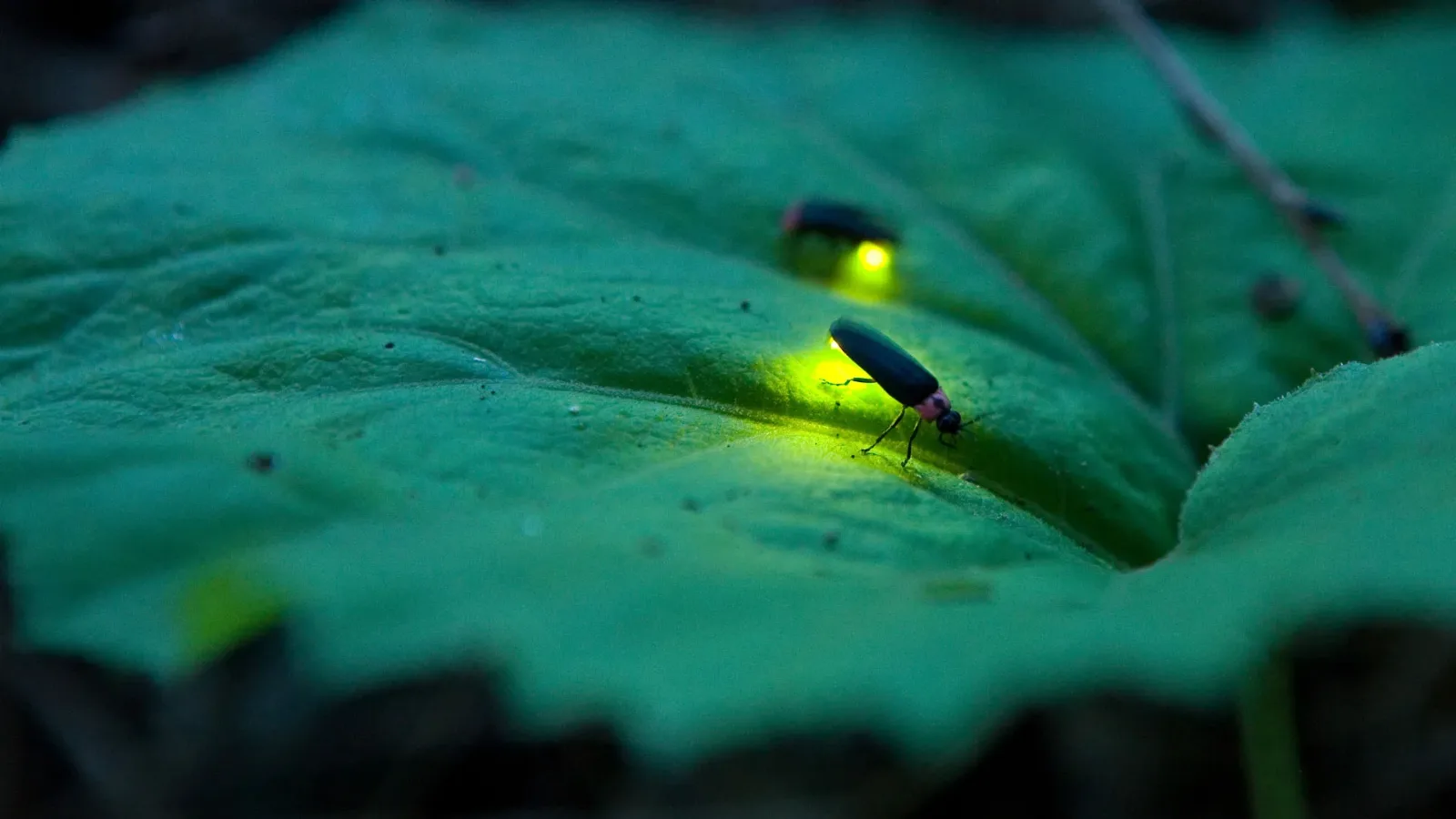
The glow is a chemical reaction that takes place in special cells in the lower abdomen. A substance called luciferin combines with oxygen, with a cell-energy molecule called ATP and with magnesium, while an enzyme called luciferase drives the reaction. The result is light. Behind the light-making cells lies a layer of tiny crystals that works like a mirror and throws the glow outward.
 The same species glowing on a leaf at night. Photo: Junyu-K, CC BY-SA 4.0, via Wikimedia Commons, resized.
Almost none of the energy turns into heat. This is why the light is called cold light, and why a firefly can glow in a cupped palm without leaving any warmth behind. A bulb wastes most of its energy as heat, while a firefly wastes very little. Most species glow somewhere between yellow and green, and the flashing is thought to be switched on and off mostly by controlling how much oxygen reaches the light-making cells.
A Language Written in Flashes
The light is mainly a way of talking. In many species the males fly low over the grass, flashing a pattern, while the females wait on leaves or on the ground and answer with a flash of their own after a precise pause. Every species has its own rhythm: the number of flashes, their length and the gap between them. A male can therefore find the right partner in a field where several kinds of firefly are flying at once.
Not every species follows this script. Some glow steadily instead of flashing. In some, the females never grow wings and stay in the grass, glowing from the ground. These wingless females are what many people mean by glow-worms. In North America, females of a genus called Photuris copy the reply flashes of other species to lure males close, and then eat them. In the mangrove forests of Malaysia, the males of one species, Pteroptyx tener, gather in thousands on riverside trees and flash in unison.
Life Before the Light
A firefly spends most of its life out of sight. The female lays her eggs on or in damp soil, moss or fallen leaves. The larvae that hatch are dark, flat and segmented, and they live on the ground. They glow too, and the glow is probably a warning to predators that they taste bad. Some eggs and pupae also give off a faint light.
The larvae are hunters. Many species feed on snails, slugs and earthworms, injecting them with fluids that turn the prey soft enough to eat. In this way fireflies can help keep down the numbers of garden and field pests. The larval stage may last from several months to two years or more, depending on the species. After a pupal stage, the adult appears.
The adult stage is short, often just a few weeks. Many adults eat very little and some do not feed at all. In that time the bhagjogni has one job: to find a mate, lay eggs and let the cycle start again. The summer light show is the last chapter of a long hidden life.
Bhagjogni and the Mithila Landscape
What a firefly needs is what Mithila has long had in plenty. North Bihar and the eastern Terai of Nepal form a flat floodplain crossed by rivers such as the Kosi, Kamla and Bagmati. The land is full of village ponds, wet paddy fields, shaded mango orchards, bamboo clumps and tall grass along field edges. All of these hold the moisture and leaf litter that firefly larvae need.
 Fireflies at Nawalparasi in the Terai of Nepal, July 2024. Photo: Mithunkunwar9, CC BY-SA 4.0, via Wikimedia Commons, resized.
The season usually begins with the first rains and carries on through the monsoon. On still, humid evenings just after dark, the lights tend to gather near ponds and standing water and then thicken over the fields and under the trees. For generations, village children have chased them, caught them in cupped hands and watched the glow leak between their fingers. A few have kept one for a night in a glass bottle or a matchbox. By morning the light has usually gone out.
Why the Lights Are Fading
Many people who grew up in villages say that fireflies were more common in the past. Hard numbers are scarce, and in Nepal no detailed study of their status exists. An international survey of firefly experts, published in 2020 in the journal BioScience, ranked the main dangers in this order: loss of habitat, artificial light at night, and pesticides. The IUCN set up a Firefly Specialist Group in 2018 to assess which species are most at risk.
Each of these dangers is easy to picture in the plains. When ponds are filled in for building and wetlands are drained, the damp ground the larvae depend on disappears. Spraying on fields and field edges can kill fireflies at every stage of life, and it also removes the snails and slugs that the larvae eat. Bright lights on roads, shops and houses make things worse, because they drown out the flashes that males and females use to find each other. A firefly that cannot see a reply may never mate.
Small Ways to Keep the Lights On
- Switch off outdoor lights that are not needed. Where a light must stay on, a shield that points the beam downward and a warm-coloured bulb do less harm.
- Leave some land a little wild: a pond with grassy banks, a patch of long grass, fallen leaves under the trees.
- Use fewer pesticides and weedkillers near ponds, ditches and the edges of fields.
- Let the insects fly free. A firefly that spends its few adult weeks in a bottle may never find a mate.
- When watching fireflies, keep torches and phone lights off, avoid camera flash, walk slowly and stay on existing paths.
Bhagjogni at a Glance
- Local names: bhagjogni (Maithili), jugnu (Hindi), junkiri (Nepali)
- What it is: a beetle of the family Lampyridae
- Known species: more than 2,000 worldwide
- Colour of the light: mostly yellow to green
- How the light is made: luciferin, luciferase, oxygen, ATP and magnesium
- Best time to see it: after dusk on humid nights, from the first rains through the monsoon
- Main threats: habitat loss, artificial light, pesticides
Questions People Ask
Do fireflies bite or sting? No. They are harmless to people and do not bite or sting.
Why do fireflies glow? Adults glow mainly to find a mate. Eggs, larvae and pupae of some species glow as a warning to predators.
Is the light hot? No. Almost all the energy becomes light and very little becomes heat, which is why it is called cold light.
How long does a bhagjogni live? The adult lives only a few weeks. The larval stage before it can last a year or more.
Are fireflies visible all year? No. The adults appear in a particular season, which in the plains of Mithila starts around the first rains.
A dark field that still blinks with small lights usually means a pond, some long grass, damp ground and fairly clean water are all still there. The bhagjogni is a tiny insect, but where it keeps coming back, the land is still healthy enough for it.
